
An Introduction to The Querencia Project: Ancestry and Identity Through Food
I was sitting with my husband on the hotel’s patio, watching thunderous waves crash onto the beach. The autumn sun had risen hot over this little corner of Mexico. Our server came by to ask what we’d prefer for breakfast. I can’t remember what we ordered, but I ordered the food in Spanish. The server stopped to ask where I was from (code for “why do you speak Spanish but appear to be a tourist here?”) — I gave the shortest explanation I have — in Spanish: I am from Colorado, but Spanish was my grandparents’ first language and they were from Nueva Mexico. Then she pounded both fists on our table and proclaimed to me passionately: “Somos Mexicanas!”
And… She’s right. But also…
I am the Conquistador.
I am the Colonizer.
I am the Colonized.
My ancestors lived their stories in their Léine and tartan Brat, their Trachten, their Smocks and Trousers, their Diil, and their Mantas. I’m proud of my roots. I’m fascinated by their convergence in me.
This project explores the history of one side of my family that has called to me for years for documentation and examination. The conquistadors, the natives, and ultimately, the mestizos that became my maternal roots…their food tells a story of identity, of resilience, of cultural evolution.
Making my grandma’s food through the years has bound up a fragile tie to our family’s history, a tie that might have otherwise frayed and disintegrated, ironically, with the integration of my family into modern American culture.
We’ll travel back to rural northern New Mexico, birthplace of my grandparents, by exploring a culinary time capsule from the region: a cookbook written by Cleofas M. Jaramillo and published in 1939, meant to preserve “Spanish recipes” in a changing world.
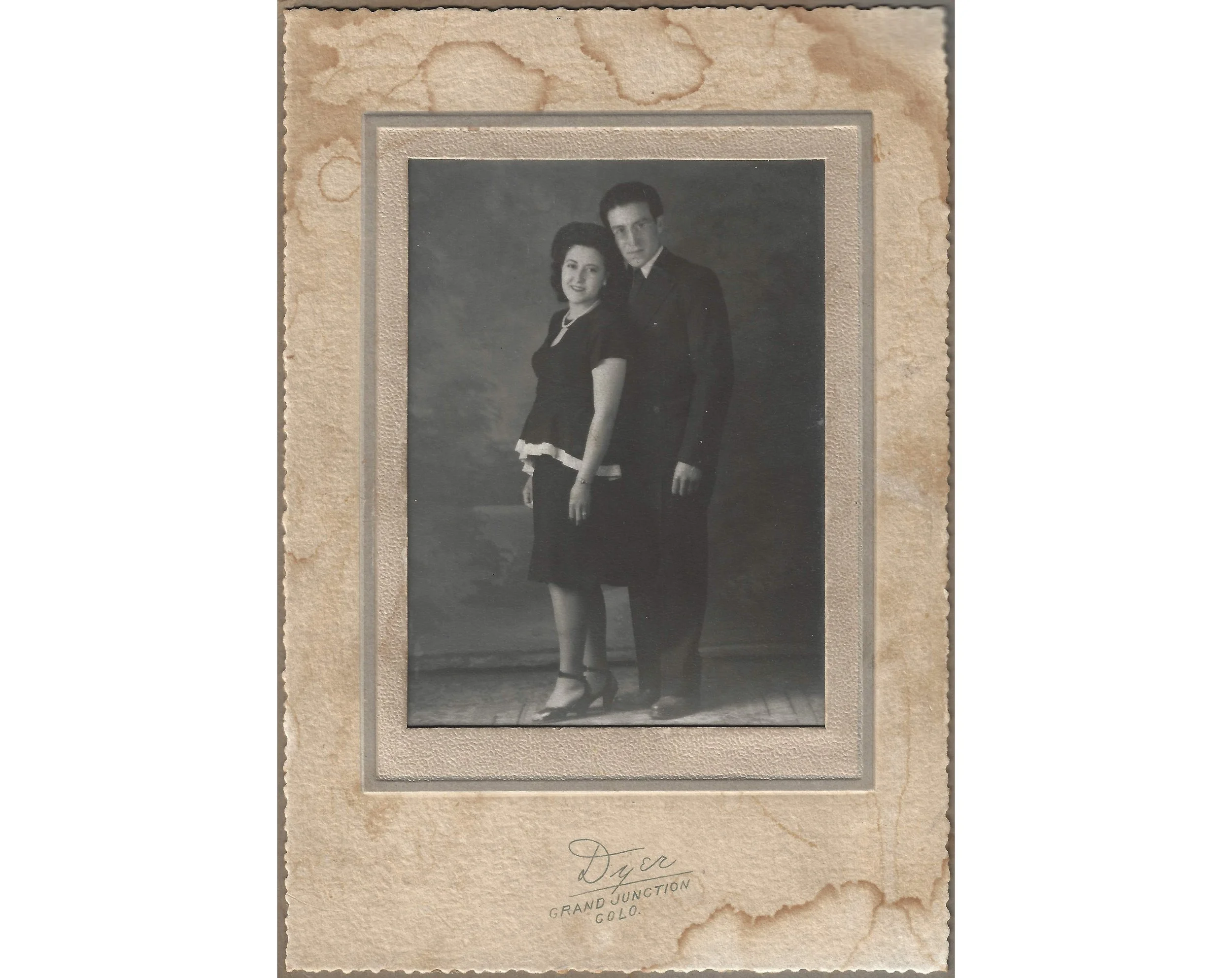
My grandparents: María and José Salazar, circa 1949 — photographed by Ray Dyer, Grand Junction, CO.
Introduction
Have you ever had an idea and then put it on the back burner for TWELVE years?
I have let a lot of life just… take over. And maybe I have let more seemingly “important” things take priority. But a few months ago, a friend asked me, “if you don’t prioritize your art, Stephanie, who will?” It was the encouragement I needed.
As I think through this project, I realize that it could create conflict. There are so many voices with claims of ownership over ALL things these days that unless you’re majority enough, minority enough, poor enough, rich enough, abused enough, healthy enough, female enough, man enough, nonbinary enough, sad enough, happy enough, religious enough, agnostic enough, etc. (should I stop?) — you have no right to talk. For many, I may not be “enough” of several things to even do this project.
Many people are complaining about division, meanwhile, they’re busy drawing big, loud lines around themselves to separate and define themselves.
Even so, I am going to push this forward because the world needs some active optimism, some ownership, and maybe even a reality check.
This project is relevant to my family’s cultural history and I think preserving that history is worth doing, especially for my children, my nieces, my nephews, and my cousins’ children. So much was nearly lost for me, my siblings, and my cousins. And so much was already lost for my mom and her siblings. Our kids deserve all the knowledge that we can gather, the stories that have yet to be told. After all, culture is the lifeblood of a community, of a people. And a culture is the brilliant fiber, blended with many others, that is woven into a beautiful tapestry that makes up our vibrant world.
Disclaimer #1
I do not intend to minimize real challenges that people have been through or are experiencing. Instead I hope to share some beauty and thoughts that might help reframe our often divided outlook on the world.
Disclaimer #2
I am HALF-hispanic and HALF-lots-of-other-cool-things (which I’m also proud of). My mom’s family traces their roots departing from Murcia, Spain, in the latter half of the 17th century to a region that is now El Paso, Texas, where they stayed for over a hundred years and then moved north to what is now northern New Mexico in the early 19th century. This is the area that culturally defines my mom’s side of the family: the Raels and Herreras of Questa, New Mexico.
First historical data point
A bunch of Spaniards (who, by the way, were previously blended with the Moors of northern Africa over several centuries) came to the Americas and did a lot of things. Some were amazing, like taking cacao and turning it into chocolate. Others were not amazing, like the conquering and mass murders of native tribes, who were busy conquering and murdering each other. And like any story of “exploration” there was exploitation and the blending of peoples and new versions of humanity continued to be made.
So, that’s how I came to be mestiza, meaning “mixed.” Or as my daughter calls me: a “Halftina.”
And instead of expending needless energy on hating the Spaniards for coming to the “new world” and probably violating some of my indigenous ancestors, I’m just going to accept that I’m not the only person with that kind of family history (try to find a culture without that story) and just be grateful to be here, living my own story.
One thing that has always been curious through my life is the way my grandparents identified themselves. If you asked them, they were “Spanish.” The “No Mexicans Allowed” signs in Colorado that they were faced with when they were young adults didn’t deter them. They “weren’t Mexican” and they would march right in. In hindsight, those stories make me laugh. Did they realize those signs were more about profiling than accuracy of citizenship? Their “Spanish family” had been in the Americas for about 300 years and had not been procreating exclusively with their Spanish community, to be clear. In fact, one of my sisters recently did an ancestry test and it turns out they were very much not exclusive. Indigenous blending in our family is actually quite recent and was arguably not for the first time. However the signs in shops and restaurants were generalizing, their identity as they saw it was not generalized.
second historical data point
Northern New Mexico was originally populated by the Puebloan Native American tribes, and the Chiricahua, Comanche, Mescalero, and Navajo tribes. It was then governed by Spain, and then Mexico, except for the parts governed by France through the Louisiana Purchase. The region of New Mexico was a territory governed by the United States for about sixty years, and became a state of the Union in 1912 — not that long ago, and only about a decade before my grandparents were born.
Somehow despite all of this, their pride for their Spanish ancestry was still so strong. They truly did not identify with the Mestizo people living further south. And it wasn’t just them.
The native peoples of the Americas had their own cultures. And when the Spanish arrived, they brought a lot of new things along with them, like their own religion and their own favorite foods (Catholicism! Cheese! Etc!). It was important to them that they continue to have the comforts of home, but they also embraced things in the “new world.” As is typical of newcomers, the Spanish wanted to hold onto their southern European culture as they made lives for themselves in a new place. The pride of their homeland and ways were passed down through generations, in spite of the ways their new home was changing them.
Old Spain in a “New World”
But what was Spanish in the 1600s-1800s in northern New Mexico wasn’t the same kind of Spanish in the early 1900s. The Spaniards had to adapt to their new environment and New Spanish Cuisine was born. Corn, beans, chiles, and squash cultivated by the native tribes became staples in their diet. Strikingly similar to what we know as Mexican Cuisine, right?
But as the USA took over governance and New Mexico was officially minted as a shiny “new” state, the people of this area were now experiencing new influences from “Americans.” Folks up north and east of them ate completely differently. Other foods had morphed from Northern European cultures into the USA and blended with indigenous foods. “American Cheese,” was widely used: an American-made cheddar and even shelf-stable Kraft American Cheese was in rotation in a New Mexican kitchen at the turn of the 19th century, even while they were simultaneously making their own sheep and goat cheese.
So, what was with the Spanish identification, three hundred years after moving continents, with generations upon generations of blending with indigenous peoples?
The IssuE
It’s an age-old issue. It’s the same issue that led to the “No Mexicans Allowed” signs in Colorado in the 1920s-1950s, denying service to Hispanic people, and blockading borders between Colorado and New Mexico. It’s the same issue that currently has some of our country in fits over deportation (if it’s truly an economic or safety issue, explain why an American teenager we are acquainted with was pulled over by ICE and questioned about her citizenship on her drive to high school about a couple months ago). It’s the issue that has maybe sent your blood pressure up reading this — because of sympathy, conviction, or sheer stubborn refusal to accept that it’s an issue. I don’t need to name the issue. The issue has become so triggering and has been used combatively from every side. But nevertheless, to date, as a country we are still dealing with this issue, even after 250 years of learning the hard way.
I believe this same issue is what kept my grandparents, their parents, and grandparents, and their community continuing to identify themselves as Spanish. You see, in their history, the Spanish were always on top. The Spanish had been the richest, the most educated, the most powerful. Not the Mexicans. But the Mexicans (who were blended with Spanish and indigenous peoples) still definitely had a leg up on the indigenous tribes, as history can attest. So any biological ties to the local “Indians” would have been left as family mythology and lore, as was mine.
The Action
When you are targeted, when you are oppressed, when you are denied service, when your opportunities are minimized by your culture, your color, your identity… and you have the option to claim something that lightens the scrutiny, you may just choose that. And if removing yourself from the scrutiny means success in your work, garners more respect, and gives your children more of a chance of life, liberty, and the pursuit of happiness than you ever dreamed of having, it might be worth living on the other side of town away from your community, like my grandpa chose to do. It might be worth hiding the tortillas when the neighbors stop by, like my grandma did. It might be worth speaking only English at home, to spare your children an accent and profiling, like my grandparents did. And it might be worth going by “Mary and Joe,” rather than “María and José,” because those names were more widely accepted in a modernized “America.”
The problem is, so much is lost when we start to conform. And the decision to conform doesn’t necessarily require a large action. Conforming can look like millions of little actions which, while small on their own, end up erasing the full picture. This is what happened in my family. And you know what? Thank goodness for good food, because famously, it’s hard to let go of the little comforts you love most, and fortunately, those comforts are often food. It has been my grandma’s food which has led me literally piece by piece back to my family’s cultural roots.
The ReclamatioN
Twelve years ago, my sister, who you will hear much more about (and from) as we progress in this project, sent me a cookbook from 1939: The Genuine New Mexico Tasty Recipes by Cleofas M. Jaramillo. Ms. Jaramillo wrote this book with intent to preserve her culture’s food history, as she knew it in 1939. These recipes would have produced the kinds of foods my grandparents ate when they were young, and the kind of food my grandma learned to cook from her mother, Jesusita, when she was a small child. And this was the kind of food she cooked for her brothers when she was just a teen to sustain them while they worked the fields, ultimately in an agricultural community in western Colorado, a town called Grand Junction.
But I’m not sure taking a leg of mutton and boiling it in water sounds as appetizing as it used to.
So, I’ll be sharing these original recipes, along with a modern edit: made for the palate of the 21st century. We have fantastic tools and gadgets now, such as refrigeration, so while a recipe may have been simplified in that era for lack of it, we are blessed to add things like cold butter and a selection of meats we didn’t raise back into the mix.
I’ll also be sharing stories: stories about my mom’s childhood and her journey into cooking. I’ll share my own stories of finally learning how to answer the question: “what are you?” I’ll be sharing my sister’s stories from her travels in New Mexico and abroad and while researching her college thesis: “Identity Expressed in Northern New Mexican Culture.” And I’ll share my own daughters’ stories about what it has meant to them to be Latina, their experience and thoughts on their identity in real time. And I’ll share the stories of others, told to me through the past few months. It’s a funny thing: when you decide to put a toe in the water (say out loud what I have determined to do and therefore hold myself accountable), it turns out my story resonates with others’ stories…and they are all stories that must be told.
Thank you for entering into this journey with me with an open heart, a curious mind, and a hungry tummy. Let’s get cooking!
-S-