
Atole Azul and the Other Original Ancestors
la familia
Famously, my ancestors came from Spain. But what about the “other” ancestors? The ones already present in Spain’s territory of Nuevo México? What were they up to and most importantly, for The Querencia Project’s purpose, what were they eating?
Interestingly, many of Sra. Jaramillo’s “Spanish recipes…excepting one or two Old Mexico recipes” includes the most American (as in Mesoamerican) ingredient. Corn. A simple ingredient, but just imagine your life without “Taco Tuesdays” and “Chips and Guac.” Would it even be worth living? To twist the knife, imagine your life without tamales. Most of the world would agree that corn is a staple.
What you may not know is that the history of corn could fill books. And does. If you want a luxurious corn-steeped-deep-dive: run, don’t walk, and buy yourself a copy of Masa, by Jorge Gaviria. He writes, “So far, the earliest evidence of equipment used specifically for masa making was discovered in Guatemala and dates back to 1500 to 1200 BCE.” The Maya, Aztecs, and other Indigenous people groups turn out to be not only skilled farmers but also brilliant biochemists. They discovered that if you boiled corn with alkali (in the form of “slaked lime or ash derived from crushed mussel and snail shells or wood”), the process created a sustaining food, making more nutrients available to the human body.
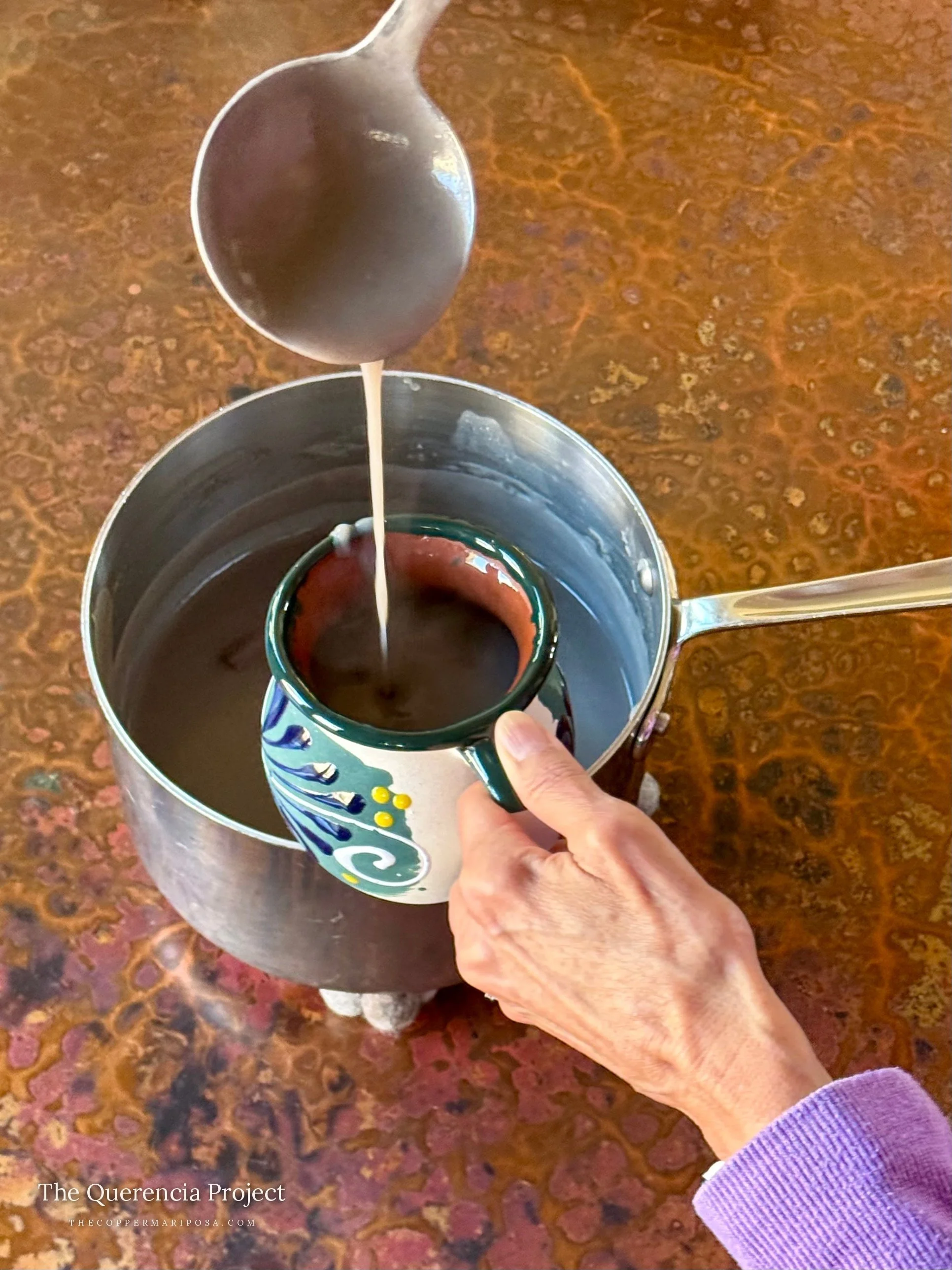
Atole Azul
what is “mexican?”
So, we’ve established that corn is not “Spanish.” It is a very native food. And it’s a defining ingredient for “Mexican” cuisine. In fact, corn originates from a region far south of my grandparents’ New Mexico in what we now know as southern Mexico. Long before the Spanish came along, Indigenous people were spreading this staple through trade, acclimating corn to both the north and south in the Americas.
But what is “Mexican,” really? Before there was Mexican there were, for example, the Maya, the Azteca (Mexica), the Zacatecos, and the Pueblos, among many other civilizations. Some of these Indigenous people and others like them lived in insular, isolated areas, but others did not. And when the Spanish arrived, new blends of humans were born, literally. Mestizos—a colonial Spanish word for European and Indigenous blended people—began to proliferate, both by force and sometimes by marriage. Their cultural identity would have evolved depending on circumstance, location, and over time, politics.
livin’ the vida casta
As is consistent with human nature, the Spanish were extremely hung up on castas. Essentially, lineage and status related to birth and socioeconomic influence. Unless you are an art historian, you may be unaware of a whole genre of paintings that were created beginning in the early 1700s depicting different castas, such as a Spaniard with an Indigenous-American mate and their child (a mestizo). You could be an elite Spaniard living on the European peninsula and commission an “exotic” casta painting to gawk at with your rich friends. Who says money doesn’t buy happiness?
“Ultimately, the casta paintings are reminders of the colonial biases in modern human history that linked a casta/ethnic society based on descent, skin color, social status, and one's birth.” — Wikipedia summarizing the work of historian María Elena Martínez that focuses on this particular genre, addressing the limpieza de sangre (purity of blood) and the Social Order in the Spanish New World.
To be completely clear, Spanish men didn’t necessarily have any issues with blending themselves with others in “New Spain.” But “as time went on” (a phrase my Grandpa Salazar used), the mixing began to matter when it came down to who held positions of power and influence. Being a Spaniard, in the end, was the most desirable.
cue: mexican war of independence
But after so many generations of blending in “New Spain,” not everyone could so easily claim Spanish ancestry to their advantage. The mestizos and the American-born Spaniards (who were also sometimes mestizo but identified as Spanish) were realizing their birthplace was a disadvantage. And just as we’ve seen throughout history, they weren’t as interested in being ruled by a country far away that they had never set foot in. The American-born Spaniards were receiving fewer privileges than Spaniards coming in to govern from the peninsula, meanwhile, the Indigenous people were bearing the burden of paying higher tribute and taxes. And so it came to be that many people living in “New Spain” were ready for a new name and new rules. That name? Mexico, named after the capital city of the territory—which made them Mexican and proud of it. Cue the Mexican War of Independence (1810-1821). Catalyzed by a priest, fought by peasants, and strangely ended and won by conservative American-born Spaniards (who thought this would be a good way to preserve Spanish Catholicism and tradition, which was at that time slightly crumbling in Spain under liberal Spaniard rule). Either way, people finally got what they hoped for: “New Spain’s” territory turned into their own country, which included present day New Mexico.
Now as you imagine these Mexican peasants fighting for their right to govern themselves, let’s think about how they fueled an eleven-year war with their European ruler.
ancient fuel meets modern day
They were absolutely eating corn.
And the simplest version of nixtamal, corn treated with lime, is ground to create masa. Blend that over a fire with more water and we have what is known as atole. Originally, this ancient Mayan drink, also enjoyed by the Aztec people long before the Spanish arrived, made its way to what is now New Mexico. The ancestors of the native Pueblo people cultivated many types of corn brought to them through trade routes as far back as 2,000 BCE, and blue corn was a special variety for them. For the Hopi, blue corn is a part of their creation story: the Guardian Spirit, Màasaw, gives them his “life and spirit” with an ear of blue corn.
The tradition of atole traveled far north from southern Mexico to nourish and sustain the Pueblo people, and eventually, my grandparents, and later, my mom and her siblings.
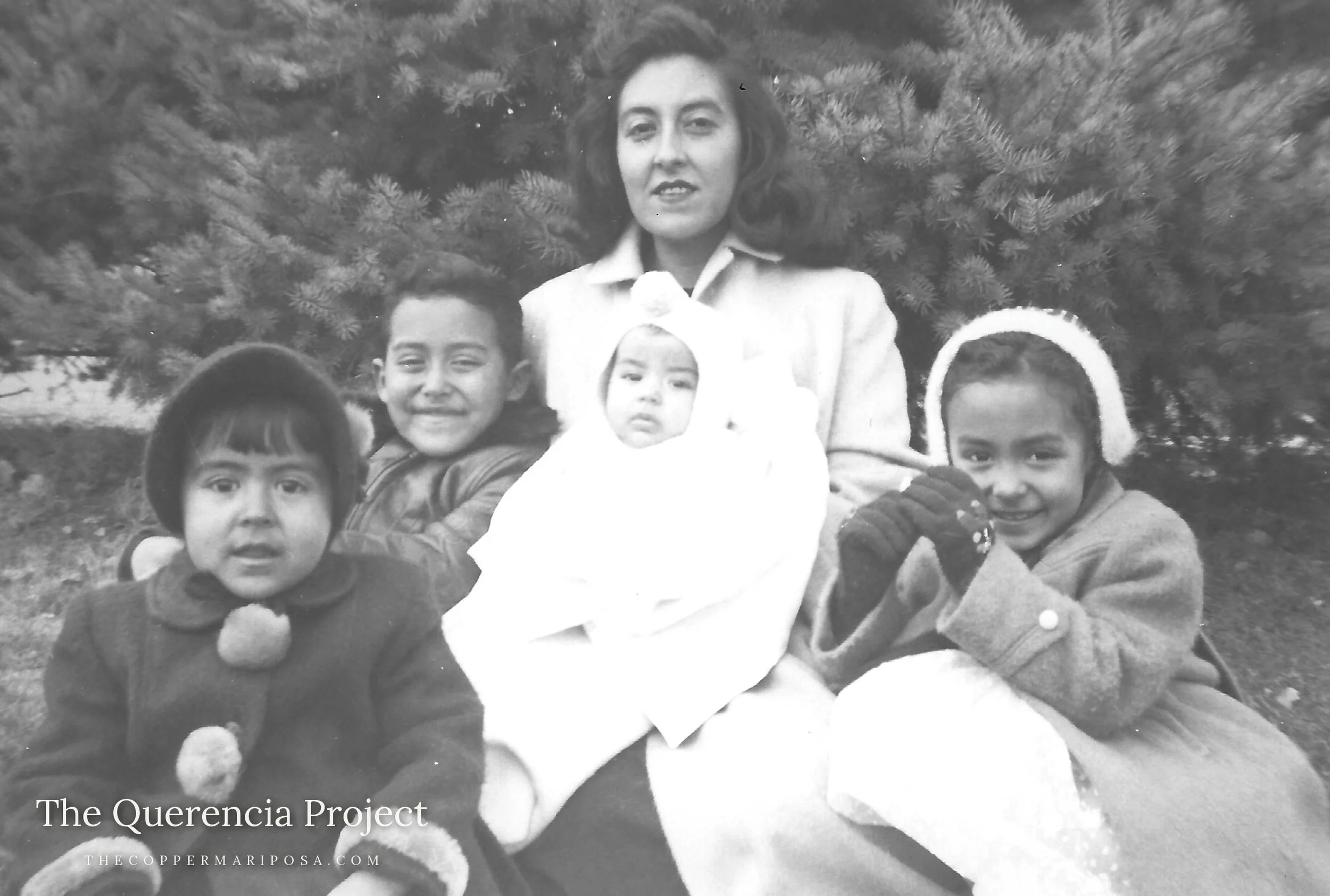
My Grandma, María “Luki” Elucrecia Herrera Salazar, and my beautiful mama (center) Rita Veronica, 4 months old, with her older siblings.
My mom remembers my Grandma Salazar making blue corn atole when she was young. It was very thin, which makes sense if you’re feeding seven children, as you’ll want to make everything stretch. Even the atole. And what a perfect snack for an active little band of cute Salazar kids. My mom says the atole of her childhood was more coarse than the one we made, which tells me that my Grandma was likely using blue corn meal, just like Sra. Jaramillo's recipe below, rather than masa harina. Imagine more of a polenta texture.
I thought it would be fun for my mom and me to make atole together and revive her childhood memories. We got together on two different mornings to make atole, sip, and chat at the kitchen table. The first was completely experimental with the process and flavors. We were a bit like Goldilocks. This one’s too salty. This one’s too thick. This one is better. But it wasn’t until we made atole again a couple weeks later that we landed on the one which was just right in texture and flavor. We were ooohing and ahhhing and absolutely relishing this comfort drink. If you can imagine having a warm hug from the inside out, this is it. Just lightly sweetened with sugar and laced with delicate Ceylon cinnamon, it’s completely delicious.
Atole azul (blue corn gruel)
by Señora Cleofas Jaramillo | The Genuine New Mexico Tasty Recipes
Sra. Jaramillo’s recipe is written for the cooks of her era. They would have already known how much water to boil, no measuring cups needed, and this recipe was merely a simple reminder of the steps.
“The blue corn is first toasted in the oven, and ground at the flour mill. Dissolve 2 tablespoons of the meal in ½ cup cold water, and add to boiling water. Stir until it boils & thickens. Cook for at least 40 minutes. Add 1 tablespoon lime water; mix well, cool, and serve with salted boiled milk.”
A modern edit
Interestingly, she is not nixtamalizing her corn here, but just toasting it before grinding, thus adding the 40 minute cook time. The lime water would have helped with color (if you want you can add a pinch of baking soda to get the same effect). And she would have likely used corn from her garden — readers would be expected to also use their own blue corn from harvest.
But the good news is, you no longer need to grow your own corn, nor do you need to add another errand to visit the local mill, and you can cut your cooking time down to a handful of minutes by using nixtamalized masa harina. Because of that, you also have the added bonus of a silky texture and B3 vitamin niacin and higher-quality proteins available to nourish your body and soul.
The railroad was built in New Mexico by 1880, so prior to that, honey would have been the sweetener of choice. But by the time Sra. Jaramillo was creating this cookbook, home cooks could buy sugar from the general store without breaking the bank. Although she doesn’t mention any sweetener in this recipe, I am, after all, writing this for the modern palette. Atole with nothing more than salted boiled milk isn’t bad, and in fact, would be great on a weak (post-flu) stomach, but for a cozy fall or winter morning, a bit of sugar with cinnamon, a staple in the New Mexican pantry, make it really nice. Call it my “artist’s impression” of the drink, and it’s an impression you’ll see almost everywhere in New Mexico.
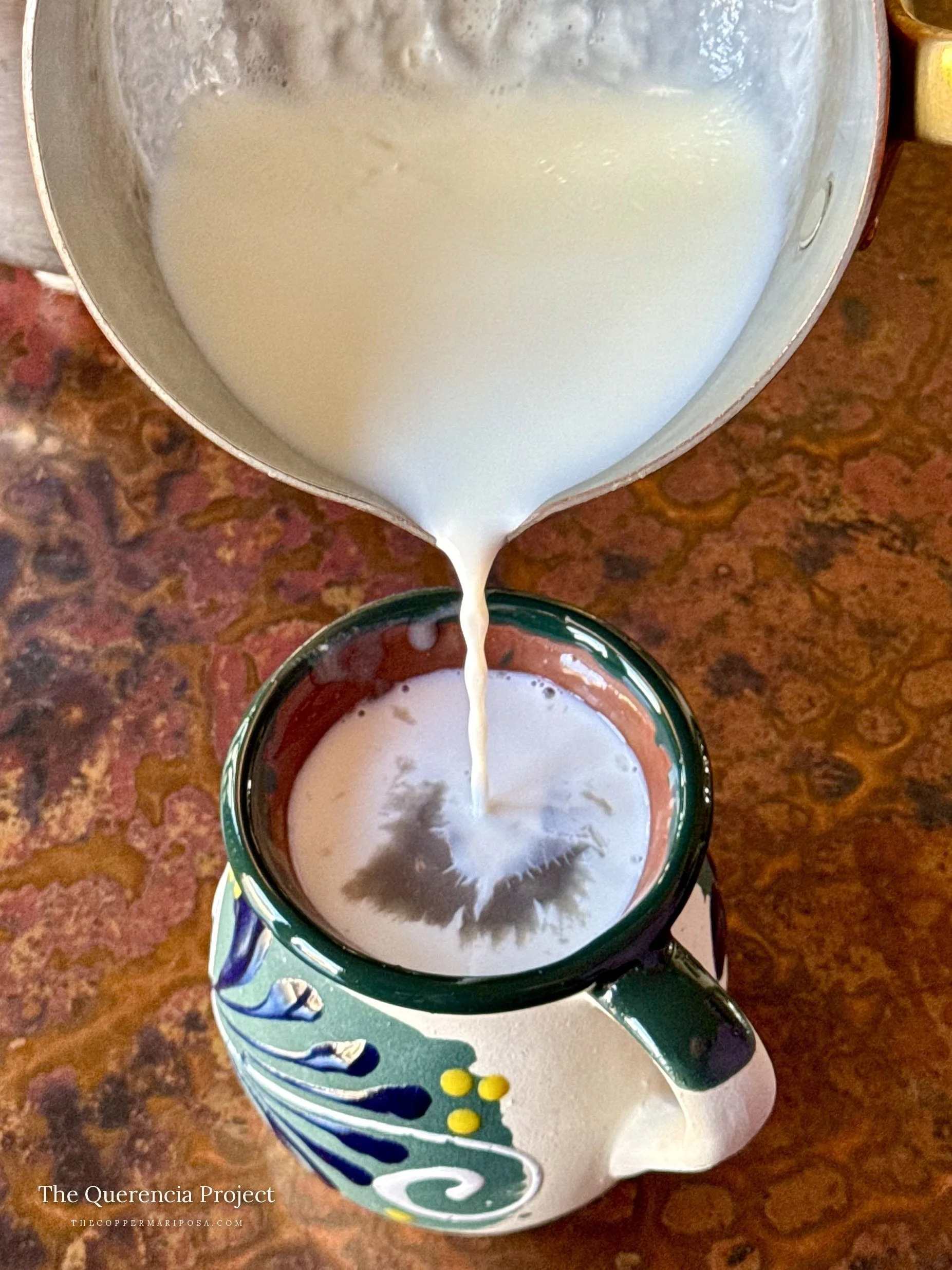
Pouring the hot salted milk over the Atole Azul
atole azul
Recipe by Stephanie Kunstle, adapted from Masa: Atole recipe by Jorge Gaviria
Watch a quick tutorial HERE.
Yield: Serves 4
Note: Masa harina is easily found, and if you want the best of the best (in my opinion), you can find delicious blue corn masa online through Masienda. It’s even available at some grocery stores.
Ingredients:
1 cup masa harina azul
2 Ceylon cinnamon sticks
3 Tbsp. sugar
¼ tsp. salt (I use pink salt for the minerals)
Optional: A pinch or two of baking soda
Separately:
1 cup scalded milk (or more as desired)
¼ tsp. salt
Preparation:
Bring 5 cups of water to boil in a medium pot, add the cinnamon sticks and salt.
Pour in the masa harina while whisking, and turn the heat down to medium, stirring frequently. Whisk well to dissolve any lumps (there may still be a few tiny ones at the end and that’s ok).
Stir in the sugar (and optional baking soda) until completely dissolved and then turn off the heat and cover your pot. Let this sit undisturbed for 10 minutes so that the cinnamon can infuse a bit.
In a small saucepan or pot, over a small flame, bring 1 cup of milk to scalding (it will just begin to quickly rise and want to boil over, so watch carefully and turn off/remove from the heat before it boils). Stir in your salt.
Using a ladle, pour the atole into a cup or mug, and serve with the hot scalded milk. The milk acts as an additional thinner and adds another layer of flavor.
Provecho!
-S-
PS: Our two adult daughters, tired of all the speculation, have taken matters (and the credit card) into their own hands: 23andMe kits are on the way for the whole family. Everyone will put their hat in the ring next week, and in the new year, I hope to share what stories our DNA has to tell about our family’s many “ingredients.”